
Level:
Correct: 0
Incorrect: 0
Marks: 0/0
Exam Practice
Course:
Topics:
Avg
score:
–
Topics
done:
0/9

Cold War crises

Practise 30 exam-style questions on Cold War crises for Edexcel GCSE History (Superpower relations and the Cold War 1941-91). Write your answer as you would in the exam and get it marked in seconds against the mark scheme, point by point, with the Study Helper on hand if you get stuck.

  • 30 questions
  • 4–8 marks each
  • Instant marking
  • No sign-up needed
20 questions, marked as you go

Sample questions with model answers

Here are 4 of the questions in this topic, each with a model answer, an explanation of why it earns the marks and the mark scheme an examiner would use.

Question 1

4 marks

Explain one consequence of Kennedy's television broadcast about Cuba (22 October 1962).

Model answer

One consequence of Kennedy's broadcast was that the crisis became a public confrontation, which at first made the Soviet Union respond defiantly. Until 22 October the discovery of the missiles had been kept secret, but that evening Kennedy revealed the missile sites to the world, announced a naval quarantine and warned that any missile launched from Cuba would bring 'a full retaliatory response upon the Soviet Union'. US forces were placed on DEFCON 3 as he spoke. Khrushchev was now publicly challenged, and on 24 October he sent a message calling the 'blockade' an 'act of aggression' and saying that Soviet ships would not obey it. On 25 October Adlai Stevenson confronted the Soviet ambassador at the UN Security Council with the photographs. With the whole world watching, neither leader could easily back down, so the danger of war increased.

Explanation

This answer reaches Level 2 because it explains what the broadcast led to (a public confrontation and a defiant Soviet response) and supports it with precise detail, including DEFCON 3, Khrushchev's message of 24 October and Stevenson's challenge at the UN. Weaker answers simply describe what Kennedy said. Be careful not to confuse this broadcast with Kennedy's speeches about Berlin in 1961 and 1963.

Mark scheme
  1. 4 marks

    Levels of response (4 marks). AO2: 2 marks. AO1: 2 marks.
    Level 2 (3-4 marks): Features of the period are analysed to explain a consequence. [AO2] Specific information about the topic is added to support the explanation, showing good knowledge and understanding of the period. [AO1]
    Level 1 (1-2 marks): Simple or generalised comment is offered about a consequence. [AO2] Generalised information about the topic is included, showing limited knowledge and understanding of the period. [AO1]
    0 marks: No rewardable material.
    Performance in AO1 and AO2 is interdependent. An answer displaying no qualities of AO2 cannot be awarded more than the top of Level 1, no matter how strong performance is in AO1; markers should note that the expectation for AO1 is that candidates demonstrate both knowledge and understanding.

    Indicative content (not a checklist; credit other valid points): On the evening of 22 October 1962 Kennedy told the American people about the 'unmistakable evidence' of Soviet offensive missile sites in Cuba (medium-range missiles able to reach Washington and sites for intermediate-range missiles), called Soviet assurances false, announced a 'strict quarantine' of offensive weapons, warned that any nuclear missile launched from Cuba would be treated as an attack by the Soviet Union requiring 'a full retaliatory response upon the Soviet Union', and called for meetings of the OAS and the UN Security Council. Valid consequences include: (1) The crisis became a public confrontation, watched across the world, which made it harder for either leader to back down openly; this is one reason why the final deal included a public US pledge not to invade Cuba while the trade over the Jupiter missiles in Turkey was kept secret. (2) The USA moved towards war readiness: US forces went to DEFCON 3 during the speech, and Strategic Air Command went to DEFCON 2 on 24 October. (3) Khrushchev at first responded defiantly: his message of 24 October called the 'blockade' an 'act of aggression' and said Soviet ships would sail on; Soviet leaders, fearing an invasion, had told their commanders in Cuba they could use all weapons except nuclear ones against an attack. (4) The OAS backed the quarantine on 23 October, so it came into force on 24 October with the support of the Americas. (5) The UN became involved: the Security Council met, and on 25 October Adlai Stevenson confronted the Soviet ambassador Zorin with the photographs; U Thant appealed to both sides. Level 2 needs a consequence explained with specific supporting information (e.g. DEFCON levels, Khrushchev's 24 October message, the OAS vote, Stevenson at the UN). A general comment such as 'people were scared' with no development is Level 1. Do not credit: a description of the contents of the speech with no consequence; the reasons for the quarantine (causation) unless linked to a result; confusion with Kennedy's 'Ich bin ein Berliner' speech (1963) or his Berlin broadcast of July 1961.
Question 2

8 marks

Write a narrative account analysing the key events in the building of the Berlin Wall, August-September 1961.

You may use the following in your answer:
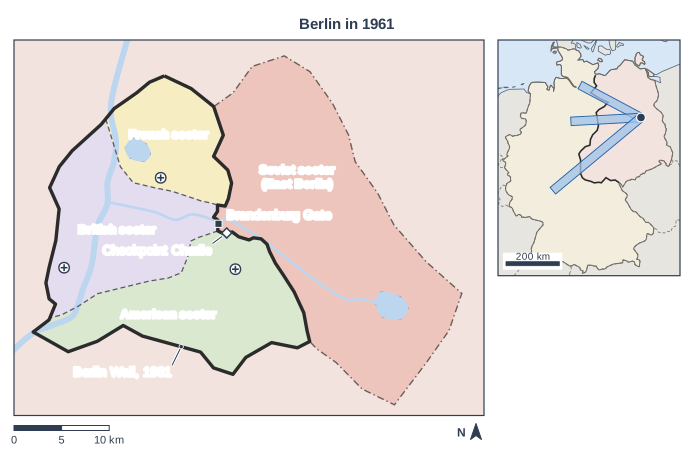
- the sealing of the border on 13 August 1961 (the line of the Wall is shown on the map)
- the first deaths at the Wall (August 1961)

You must also use information of your own.

Plan of a divided city with an inset map of its country. The heading reads "Berlin in 1961". Plan (north at the top) with a scale bar and north arrow, showing a city divided into four shaded areas: a large area in the east and three areas in the west (north, west and south), separated by dashed lines; a dash-dot line marks the edge of the city, which is surrounded by pale pink land. Pale blue rivers and lakes run through it. A thick black line runs all the way round the three western areas, through the middle of the city and round its outer edge. A small dark square and, just south-east of it, a white diamond sit on the line in the centre. Three airfield symbols are in the western half: one in the south-centre, one on the far western edge and one in the north-west. To the right, an inset map shows a country divided by a north-south line into a western part and an eastern part shaded pink, with a dot deep inside the eastern part joined to three cities in the western part by blue bands. The scale bar shows 10 km. The label "American sector" is written on the shaded area in the south of the western half of the city; the label "British sector" is written on the shaded area in the west of the western half of the city; the label "French sector" is written on the shaded area in the north of the western half of the city; the label "Soviet sector (East Berlin)" is written on the shaded area in the east of the city; the label "Berlin Wall, 1961" points to the thick black line all the way round the western half of the city; the label "Brandenburg Gate" points to the small dark square on the border between the western and eastern halves, in the centre of the city; the label "Checkpoint Charlie" points to the white diamond on the border just south-east of the small dark square.

Model answer

In the early hours of 13 August 1961, East German border police, soldiers and factory militia sealed the border between East and West Berlin. Barbed wire and fences were put up through the city and around West Berlin, streets were torn up and the S-Bahn and U-Bahn were cut. Because Kennedy had only promised to defend West Berlin, the Western powers protested but did nothing to stop it.

At first the barrier was weak. On 15 August a young East German guard, Conrad Schumann, leapt over the wire, and people climbed through gaps or out of windows. As a result, the East German authorities quickly strengthened it: from mid-August concrete blocks replaced the wire and the doors and windows of houses on the border, such as those in Bernauer Strasse, were bricked up. Meanwhile Kennedy sent Vice-President Johnson and General Clay to West Berlin, and on 20 August 1,500 American troops arrived along the autobahn. This reassured West Berliners, but it also showed that the USA would not try to tear the barrier down.

The determination of people to escape led to the first deaths. On 22 August Ida Siekmann died after jumping from her window in Bernauer Strasse, and on 24 August Günter Litfin was shot dead by East German police as he tried to swim across the Humboldt harbour to West Berlin. These deaths showed that escape now risked death, so the flow of refugees, which had reached about 30,000 in July, almost stopped. From late August West Berliners were also banned from entering East Berlin.

Even so, some people kept trying to escape, so in September the East German authorities tightened the border further. Windows facing West Berlin were bricked up, and on 24 September they began forcibly moving the residents out of the houses in Bernauer Strasse. The outcome was that by the end of September 1961 the barbed wire of 13 August had become a permanent, guarded barrier round West Berlin, the flood of refugees had been reduced to a trickle, and Berlin was divided in a way that would last until 1989.

Explanation

A top-level answer explains how the events were linked: the weak first barrier and early escapes led to the concrete wall and to guards firing on escapers, the deaths stopped the refugee flow, and continued escapes led to the bricking-up and clearing of the houses on the border. It uses own knowledge beyond the stimulus points, such as Conrad Schumann, Bernauer Strasse and the arrival of US troops. Weaker answers describe the Wall rather than the sequence of events, or drift into later events, such as the Checkpoint Charlie stand-off of October 1961, that fall outside the dates.

Mark scheme
  1. 8 marks

    Levels of response (8 marks). AO2: 4 marks. AO1: 4 marks.
    Level 3 (6-8 marks): A narrative is given which organises material into a clear sequence of events leading to an outcome. The account of events analyses the linkage between them and is coherent and logically structured. [AO2] Accurate and relevant information is included, showing good knowledge and understanding of the key features or characteristics of the events. [AO1] No access to Level 3 for answers that do not address three or more aspects of content.
    Level 2 (3-5 marks): A narrative is given, showing some organisation of material into a sequence of events leading to an outcome. The account of events shows some analysis of the linkage between them, but some passages of the narrative may lack coherence and organisation. [AO2] Accurate and relevant information is added, showing some knowledge and understanding of the events. [AO1]
    Level 1 (1-2 marks): A simple or generalised narrative is provided; the account shows limited analysis and organisation of the events included. [AO2] Limited knowledge and understanding of the events is shown. [AO1]
    0 marks: No rewardable material.
    Performance in AO1 and AO2 is interdependent. An answer displaying no qualities of AO2 cannot be awarded more than the top of Level 1, no matter how strong performance is in AO1; markers should note that the expectation for AO1 is that candidates demonstrate both knowledge and understanding.

    Indicative content (not a checklist; credit other valid points): The map shows Berlin in 1961: the American, British and French sectors (West Berlin) and the Soviet sector (East Berlin), with the line of the Wall through the city and round the outside of West Berlin, the Brandenburg Gate and Checkpoint Charlie. Key events in sequence, with links: During the night of 12-13 August 1961 East German border police, soldiers and factory militia sealed the border with barbed wire and fences right round West Berlin (about 155 km, including about 43 km through the city); streets were torn up, S-Bahn and U-Bahn lines were cut and most crossing points closed, with Soviet troops in the background. The Western powers protested but did not act, because their commitments covered West Berlin, not the sector border. The barrier was still weak (on 15 August a young East German border guard, Conrad Schumann, leapt over the wire), so the authorities strengthened it: from about 15-17 August concrete blocks and walls began to replace the wire, and doors and windows of houses on the border, as in Bernauer Strasse, were bricked up. Kennedy sent Vice-President Johnson and General Clay to West Berlin (19 August) and 1,500 US troops drove down the autobahn to the city (20 August), reassuring West Berliners but making no attempt to remove the barrier. People still tried to escape: on 22 August Ida Siekmann died after jumping from her window in Bernauer Strasse, and on 24 August Günter Litfin was shot dead by East German transport police while trying to swim to West Berlin across the Humboldt harbour, the first person shot dead at the Wall: guards now fired on people trying to escape. These deaths showed that escape now risked death, and the flow of refugees almost stopped. From late August West Berliners were barred from East Berlin. Escapes still went on (some border guards deserted, and people climbed through gaps or escaped from the windows of border houses), so the barrier was extended and strengthened: windows facing West Berlin were bricked up, and on 24 September the authorities began forcibly moving residents out of the houses in Bernauer Strasse; some residents jumped from their windows to reach the West before they could be moved. Outcome: by the end of September 1961 the barbed wire had become a permanent, guarded barrier right round West Berlin, the flood of refugees had been reduced to a trickle, and the city was divided in a way that lasted until 1989, while the Western powers had protested but made no attempt to remove it. Answers should show how each event led to the next (e.g. escapes led to a stronger barrier and to guards firing on escapers). Answers that use only the two stimulus points without a third aspect of content cannot reach Level 3. Do not credit material after September 1961 (e.g. the Checkpoint Charlie stand-off of October 1961, the death of Peter Fechter in 1962, Kennedy's 1963 visit) except as a brief concluding comment; the claim that the Wall was built on West Berlin territory or by the Western powers.

    Pearson's marking instructions: The middle mark in Levels 2 and 3 may be achieved by stronger performance in either AO1 or AO2.

Question 3

8 marks

Write a narrative account analysing the key developments in the ending of the Cuban Missile Crisis, 26 October-20 November 1962.

You may use the following in your answer:
- Khrushchev's broadcast on Radio Moscow (28 October 1962)
- the dispute over the IL-28 bombers (November 1962)

You must also use information of your own.

Model answer

By 26 October 1962 the quarantine had stopped any more Soviet weapons reaching Cuba, but the missiles already there were almost ready to fire, and Kennedy believed that only an attack would remove them. That evening Khrushchev sent a letter offering to remove the weapons if the USA promised not to invade Cuba. Hopes were raised, but on 27 October a second message demanded that the USA also remove its Jupiter missiles from Turkey, and a U-2 was shot down over Cuba, killing its pilot. Kennedy decided not to retaliate. Instead he replied to the first letter with a no-invasion pledge, and Robert Kennedy secretly told the Soviet ambassador that the Jupiters would soon be removed, but that an answer was needed within a day.

Alarmed that events were slipping out of his control, Khrushchev announced on Radio Moscow on 28 October that the missiles would be dismantled and returned to the Soviet Union. This broadcast ended the immediate danger of war, but it created a new problem with Cuba. Castro had not been consulted and was furious, so when U Thant visited Havana on 30-31 October, Castro refused to allow UN inspectors onto Cuban soil. As a result, the USA checked the withdrawal at sea, photographing the missiles on the decks of Soviet ships as they left Cuba on 5-9 November.

One issue was still unresolved. The USA insisted that the IL-28 bombers in Cuba were also offensive weapons, so Kennedy kept the quarantine in place. The Soviet leader Mikoyan spent weeks in Havana trying to persuade Castro, who did not want to lose them. Finally, on 20 November, Khrushchev agreed to remove the bombers, and Kennedy announced the end of the quarantine. The crisis was over: the missiles and bombers were leaving Cuba, the USA had promised not to invade, and the Jupiters were removed secretly from Turkey the following spring.

Explanation

A top-level narrative shows how each development led to the next: the danger of 27 October pushed both sides to a deal, Khrushchev's broadcast ended the immediate threat but angered Castro, Castro's refusal of inspection led to checks at sea, and the IL-28 dispute kept the quarantine going until 20 November. Strong answers use own knowledge beyond the stimulus points, such as U Thant's visit and Mikoyan's mission. Weaker answers stop at 28 October or confuse the two letters.

Mark scheme
  1. 8 marks

    Levels of response (8 marks). AO2: 4 marks. AO1: 4 marks.
    Level 3 (6-8 marks): A narrative is given which organises material into a clear sequence of events leading to an outcome. The account of events analyses the linkage between them and is coherent and logically structured. [AO2] Accurate and relevant information is included, showing good knowledge and understanding of the key features or characteristics of the events. [AO1] No access to Level 3 for answers that do not address three or more aspects of content.
    Level 2 (3-5 marks): A narrative is given, showing some organisation of material into a sequence of events leading to an outcome. The account of events shows some analysis of the linkage between them, but some passages of the narrative may lack coherence and organisation. [AO2] Accurate and relevant information is added, showing some knowledge and understanding of the events. [AO1]
    Level 1 (1-2 marks): A simple or generalised narrative is provided; the account shows limited analysis and organisation of the events included. [AO2] Limited knowledge and understanding of the events is shown. [AO1]
    0 marks: No rewardable material.
    Performance in AO1 and AO2 is interdependent. An answer displaying no qualities of AO2 cannot be awarded more than the top of Level 1, no matter how strong performance is in AO1; markers should note that the expectation for AO1 is that candidates demonstrate both knowledge and understanding.

    Indicative content (not a checklist; credit other valid points): Key developments in sequence, with links: By 26 October the quarantine had stopped further shipments but the missile sites in Cuba were nearly ready, and Kennedy believed only an attack would remove them. That day a KGB officer, Fomin, suggested a deal to the journalist John Scali, and in the evening Khrushchev's first letter offered to remove the weapons if the USA promised not to invade Cuba. On 27 October ('Black Saturday') a second, public message demanded the removal of the US Jupiter missiles from Turkey, and a U-2 was shot down over Cuba, killing Major Rudolf Anderson; Kennedy chose not to retaliate. He replied to the first letter, offering a pledge not to invade in return for the removal of the missiles under UN supervision, and Robert Kennedy told Ambassador Dobrynin that the Jupiters would be removed soon (but secretly) and that an answer was needed within a day. On 28 October Khrushchev, alarmed that events were slipping out of control, announced on Radio Moscow that the missiles would be dismantled, crated and returned to the Soviet Union; Kennedy welcomed this as an important contribution to peace. Castro, who had not been consulted, was furious; he refused to allow UN inspection on Cuban soil when U Thant visited Havana (30-31 October), although Anderson's body was returned. Instead the USA checked the withdrawal at sea: the ships carrying the missiles left Cuba on 5-9 November and were inspected from the air and by US warships as they passed the quarantine line. The USA also insisted that the IL-28 bombers were offensive weapons, so it kept the quarantine in place; the Soviet leader Anastas Mikoyan spent weeks in Havana persuading a reluctant Castro. Outcome: on 20 November Khrushchev agreed to remove the IL-28s and Kennedy ended the quarantine, formally ending the crisis (the bombers were shipped out in early December and the Jupiters were removed from Turkey and Italy by April 1963). Answers should show how each development led to the next. Answers that use only the two stimulus points without a third aspect of content cannot reach Level 3. Do not credit: the hotline or the Limited Test Ban Treaty (1963) except as a brief concluding comment; the claim that the Jupiter deal was announced publicly in 1962; the claim that UN inspectors checked the sites in Cuba.

    Pearson's marking instructions: The middle mark in Levels 2 and 3 may be achieved by stronger performance in either AO1 or AO2.

Question 4

8 marks

Explain the importance of Alexander Dubček for the re-establishment of Soviet control in Czechoslovakia in the years 1968-69.

Model answer

Alexander Dubček was important for the re-establishment of Soviet control in Czechoslovakia, even though he had led the reforms that Moscow wanted to destroy.

At first the Soviet leaders tried to manage without him. Dubček was arrested on 21 August 1968 and flown to the Soviet Union, but the hardliners failed to form a pro-Soviet government because Czechoslovaks refused to cooperate. Moscow therefore needed him. He was brought into the talks in Moscow, signed the Moscow Protocol and returned to Prague on 27 August as party leader. This mattered because his authority made the Protocol acceptable: he appealed to the people for calm, open protest faded, and the Central Committee approved the Protocol.

Dubček then carried out Moscow's demands step by step. Censorship was restored in September 1968, reformers lost their posts, and in October the Czechoslovak leadership accepted a treaty allowing Soviet troops to stay. He and his colleagues were repeatedly summoned to Moscow to receive new demands. In this way the Soviet Union used the reformers themselves to undo the Prague Spring, without the bloodshed seen in Hungary in 1956.

However, Dubček also slowed the process. He tried to save parts of the reforms, such as the federal system that began in January 1969, and many Czechoslovaks still saw him as their hope; protest continued, for example after Jan Palach's death in January 1969. When the anti-Soviet riots after the ice hockey victories of March 1969 showed that he could not keep order, Moscow demanded firm action, and on 17 April 1969 Dubček was forced to resign. His replacement, Gustáv Husák, then completed 'normalisation'.

Overall, Dubček was important because he gave the first stages of the re-establishment of Soviet control an appearance of legitimacy, but his popularity meant that Moscow could only complete it by removing him.

Explanation

A top-level answer explains how Dubček's actions after the invasion helped Moscow (signing the Moscow Protocol, appealing for calm, carrying out its demands) and how his popularity also slowed the process until he was removed in April 1969. It uses precise detail such as the restoration of censorship and the treaty of October 1968. Weaker answers describe the Prague Spring reforms of early 1968 instead of what happened after the invasion.

Mark scheme
  1. 8 marks

    Levels of response (8 marks). AO2: 4 marks. AO1: 4 marks.
    Level 3 (6-8 marks): An explanation is given, showing analysis of importance. It shows a line of reasoning that is coherent and logically structured. [AO2] Accurate and relevant information is included, showing good knowledge and understanding of the required features or characteristics of the period studied. [AO1]
    Level 2 (3-5 marks): An explanation is given, showing an attempt to analyse importance. It shows some reasoning, but some passages may lack coherence and organisation. [AO2] Accurate and relevant information is added, showing some knowledge and understanding of the period. [AO1]
    Level 1 (1-2 marks): A simple or generalised answer is given, showing limited development and organisation of material. [AO2] Limited knowledge and understanding of the topic is shown. [AO1]
    0 marks: No rewardable material.
    Performance in AO1 and AO2 is interdependent. An answer displaying no qualities of AO2 cannot be awarded more than the top of Level 1, no matter how strong performance is in AO1; markers should note that the expectation for AO1 is that candidates demonstrate both knowledge and understanding.

    Indicative content (not a checklist; credit other valid points): After the invasion of 20-21 August 1968 Dubček was arrested and flown to the Soviet Union, but because the hardliners failed to form a pro-Soviet government he was brought into the Moscow talks (23-26 August), signed the Moscow Protocol and returned to Prague on 27 August as First Secretary; he was forced to resign on 17 April 1969. Ways he mattered for the re-establishment of Soviet control: (1) He gave the Moscow Protocol authority: by signing it (only František Kriegel refused) and appealing on his return for calm and acceptance of the 'temporary' measures, he helped to persuade a resisting party and people to accept the occupation; open protest faded and the Central Committee approved the Protocol on 31 August. (2) He carried out Moscow's demands step by step: censorship was restored in September 1968, leading reformers lost their posts, and the Czechoslovak leadership accepted the treaty of 16 October 1968 allowing Soviet troops to stay; he and other leaders were repeatedly summoned to Moscow (e.g. in October 1968) to receive new demands. (3) Because he was so popular, the reforms could be undone gradually by the reformers themselves, without the bloodshed of Hungary in 1956; Moscow did not have to rely on the discredited hardliners. (4) But his presence also slowed the process: he tried to keep parts of the reforms (the federation of Czech and Slovak republics took effect on 1 January 1969), many Czechoslovaks still saw him as their hope, and protest continued (e.g. after Jan Palach's death in January 1969). (5) His failure to keep order gave Moscow its chance to remove him: after the anti-Soviet riots that followed the ice hockey victories over the Soviet Union (March 1969) the Soviet leaders demanded firm action, stricter censorship followed on 2 April, and on 17 April Dubček resigned and Gustáv Husák replaced him, so full 'normalisation' could begin. (6) Credit, if linked: his later fate (sent as ambassador to Turkey, expelled from the party in 1970) showed that even the most popular leader could be removed. Top-level answers explain how the reform leader was used to undo his own reforms, and weigh this against the ways he delayed the restoration of control. Do not credit: a description of the Prague Spring reforms of January-August 1968 not linked to the re-establishment of control; the claim that Dubček invited the invasion; the claim that Dubček was executed or imprisoned; confusion of Dubček with Husák or with President Svoboda.

    Pearson's marking instructions: The middle mark in Levels 2 and 3 may be achieved by stronger performance in either AO1 or AO2.

Ready to try the rest? Every answer you write is marked against the mark scheme, so you can see exactly where the marks are.

Study Helper Hints first, answers after you try

Stuck on this one? Ask for a hint and I’ll point you in the right direction, without giving the answer away. Once you’ve checked your answer, I’ll show you how the marks are awarded.