
Level:
Correct: 0
Incorrect: 0
Marks: 0/0
Exam Practice
Course:
Topics:
Avg
score:
–
Topics
done:
0/9

Migration and early settlement

Practise 30 exam-style questions on Migration and early settlement for Edexcel GCSE History (The American West c1835-c1895). Write your answer as you would in the exam and get it marked in seconds against the mark scheme, point by point, with the Study Helper on hand if you get stuck.

  • 30 questions
  • 4–8 marks each
  • Instant marking
  • No sign-up needed
20 questions, marked as you go

Sample questions with model answers

Here are 4 of the questions in this topic, each with a model answer, an explanation of why it earns the marks and the mark scheme an examiner would use.

Question 1

4 marks

Explain one consequence of the Donner Party's decision to take the Hastings Cutoff (shown on the map) in 1846.
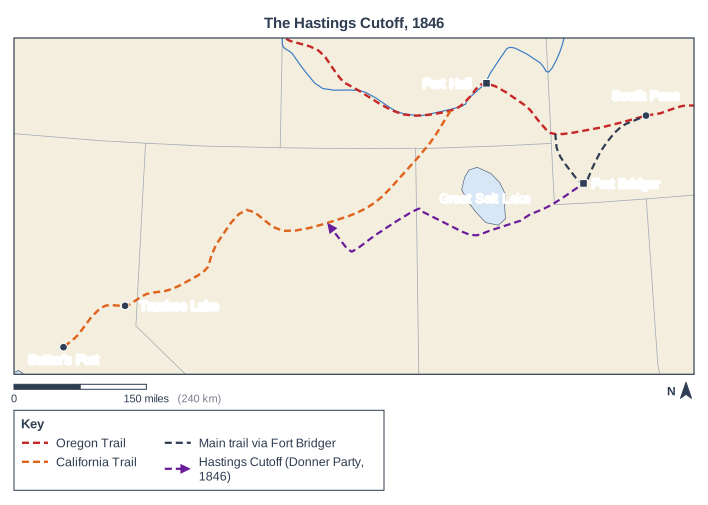
Map of part of the United States from 122.5°W to 108.3°W and 38.3°N to 43.6°N, titled "The Hastings Cutoff, 1846", showing modern state borders (thin grey lines). Land is pale buff, neighbouring countries pale grey, and the sea and lakes pale blue; the borders are today's, not those of the time; a north arrow shows north at the top; the scale bar is 150 miles (240 km) long. Blue lines show a river (not named). Points: a dot labelled "Sutter's Fort" (in California); a dot labelled "South Pass" (in Wyoming); a small black square labelled "Fort Bridger" (in Wyoming); a small black square labelled "Fort Hall" (in Idaho); the words "Great Salt Lake" (in Utah); a dot labelled "Truckee Lake" (in California). Lines drawn: a red dashed line (key: "Oregon Trail") running from the edge of the map (in Wyoming) to the edge of the map (in Oregon), passing through Idaho; an orange dashed line (key: "California Trail") running from Idaho to the point labelled "Sutter's Fort", passing through Utah, Nevada and California (it branches off the red dashed line (key: "Oregon Trail")); a dashed dark line (key: "Main trail via Fort Bridger") running from the point labelled "South Pass" to Wyoming; a dashed purple line with an arrowhead at its end (key: "Hastings Cutoff (Donner Party, 1846)") running from the point labelled "Fort Bridger" to Nevada, passing through Wyoming and Utah. The key (below the map) shows: "Oregon Trail", "California Trail", "Main trail via Fort Bridger" and "Hastings Cutoff (Donner Party, 1846)".

Model answer

One consequence of the decision to take the Hastings Cutoff was that the Donner Party fell so far behind that it was trapped by snow in the Sierra Nevada. Lansford Hastings claimed his route from Fort Bridger would save time, but no wagons had used the route he advised through the Wasatch Mountains. The men had to cut their own road through trees and rocks, and at times managed only about one and a half miles a day. Then the crossing of the Great Salt Lake Desert, which Hastings said would take two days, took six, and many oxen died or ran off. When the party rejoined the main trail on the Humboldt River in late September, it was about a month behind. It therefore reached the mountains in late October, just as heavy snow blocked the pass, and only about half of its 87 members survived.

Explanation

A Level 2 answer explains how the decision led to a specific result, such as the delay that left the party trapped by snow, the loss of oxen and wagons, or the quarrels that split the group, and supports it with detail such as the road through the Wasatch Mountains or the six days in the salt desert. Weaker answers retell the whole story of the Donner Party without making the link to the cutoff. Handle the deaths factually and avoid sensational detail.

Mark scheme
  1. 4 marks

    Levels of response (4 marks). AO2: 2 marks. AO1: 2 marks.
    Level 2 (3-4 marks): Features of the period are analysed to explain a consequence. [AO2] Specific information about the topic is added to support the explanation, showing good knowledge and understanding of the period. [AO1]
    Level 1 (1-2 marks): Simple or generalised comment is offered about a consequence. [AO2] Generalised information about the topic is included, showing limited knowledge and understanding of the period. [AO1]
    0 marks: No rewardable material.
    Performance in AO1 and AO2 is interdependent. An answer displaying no qualities of AO2 cannot be awarded more than the top of Level 1, no matter how strong performance is in AO1; markers should note that the expectation for AO1 is that candidates demonstrate both knowledge and understanding.

    Indicative content (not a checklist; credit other valid points): (1) The party was badly delayed, so it reached the Sierra Nevada too late. On 20 July 1846, at the Little Sandy River, most of the wagon train chose the established route to Fort Hall, but the group that became the Donner Party went to Fort Bridger to follow Lansford Hastings' untested route, which left the trail there; they set out from Fort Bridger on 31 July, about eleven days behind the first party to use the cutoff. There was no road through the Wasatch Mountains, so the men had to cut one, clearing trees, brush and rocks; progress fell to about one and a half miles a day and the crossing took about two weeks. Hastings had said the Great Salt Lake Desert was about 40 miles and two days; it was about 80 miles and took six days. The party rejoined the main California Trail on the Humboldt River on 26 September, about a month later than it would otherwise have done, so it reached the Sierra Nevada at the end of October and was trapped by early, heavy snow at Truckee Lake and Alder Creek for the winter of 1846-47; only about half of the 87 people survived (accept 45-48 survivors, or about 40 deaths). (2) Animals and wagons were lost: in the salt desert many oxen died or ran off (James Reed lost nine of his ten) and several wagons were abandoned, so food ran short and Charles Stanton and William McCutchen were sent ahead to Sutter's Fort for supplies. (3) Quarrels and division: the members blamed Reed and Hastings; on the Humboldt, Reed killed John Snyder in a fight and was banished (October 1846), and families split into groups that would not help each other. Credit that Reed then reached Sutter's Fort and later led a relief party. (4) The road the party cut through the Wasatch Mountains was used by the Mormon pioneer company in July 1847 and became the main road into the Salt Lake valley. (5) The disaster discouraged later wagon trains from using the cutoff; after a few gold seekers used it in 1849-50 it was largely abandoned. For Level 2 the consequence must be linked explicitly to the decision to take the cutoff, with specific supporting detail. Do not credit: claims that the cutoff was shorter in practice (Hastings claimed it would save as much as 200 miles, but the road-building in the Wasatch, the desert crossing and the long loop round the Ruby Mountains made it longer and much slower than the route via Fort Hall); claims that the party was attacked and destroyed by Indigenous peoples of the Plains; confusion with the Oregon Trail or the Mormon migration.

Question 2

8 marks

Explain the importance of the promise of free land for migration to Oregon in the years 1843-55.

Model answer

The promise of free land was probably the most important reason why families chose to make the long journey to Oregon. Many of the early emigrants were farmers from the Mississippi valley who had been hit by the depression after 1837 and were in debt. Elsewhere in the USA, government land cost at least 1.25 dollars an acre, but in 1843 the settlers' provisional government in the Willamette Valley allowed each settler to claim up to 640 acres free, as long as they lived on and improved it. Some people went even before this, in the hope that Congress would grant land: Peter Burnett, for example, hoped that a bill proposed by Senator Linn would give him land to pay off his debts when he joined the Great Migration of 1843.

The promise became even more important after the Donation Land Claim Act of 1850. It gave 320 acres to an unmarried white male citizen and 640 acres to a married couple who arrived before December 1850, with half these amounts for later arrivals until 1855, as long as they farmed the land for four years. Because a couple could claim twice as much, the law encouraged whole families to migrate, so Oregon was settled mainly by farming families, unlike the mostly male gold rush in California. Thousands of claims were made under the Act.

However, the promise was limited. It excluded Black settlers and most Indigenous people, and the land given away was taken from Indigenous nations such as the Kalapuya of the Willamette Valley. It also had to compete with other attractions: after 1848 many migrants headed for California's goldfields instead. Even so, free land explains why so many families were willing to risk the Oregon Trail in these years.

Explanation

The best answers explain how the land offer made people decide to migrate, using precise details such as the 640-acre claims of 1843 and the terms of the Donation Land Claim Act (1850). A common error is to write about the Homestead Act of 1862, which belongs to a later part of the course. Strong answers may also explain who was excluded and how other factors limited the importance of land.

Mark scheme
  1. 8 marks

    Levels of response (8 marks). AO2: 4 marks. AO1: 4 marks.
    Level 3 (6-8 marks): An explanation is given, showing analysis of importance. It shows a line of reasoning that is coherent and logically structured. [AO2] Accurate and relevant information is included, showing good knowledge and understanding of the required features or characteristics of the period studied. [AO1]
    Level 2 (3-5 marks): An explanation is given, showing an attempt to analyse importance. It shows some reasoning, but some passages may lack coherence and organisation. [AO2] Accurate and relevant information is added, showing some knowledge and understanding of the period. [AO1]
    Level 1 (1-2 marks): A simple or generalised answer is given, showing limited development and organisation of material. [AO2] Limited knowledge and understanding of the topic is shown. [AO1]
    0 marks: No rewardable material.
    Performance in AO1 and AO2 is interdependent. An answer displaying no qualities of AO2 cannot be awarded more than the top of Level 1, no matter how strong performance is in AO1; markers should note that the expectation for AO1 is that candidates demonstrate both knowledge and understanding.

    Indicative content (not a checklist; credit other valid points): (1) Land was the main attraction for farm families, especially after the depression that followed 1837. In 1843 the settlers' provisional government in the Willamette Valley passed Organic Laws allowing a settler to claim up to 640 acres (one square mile) free of charge, provided it was occupied and improved; this was far more than most could afford elsewhere in the USA, where government land cost at least 1.25 dollars an acre. (2) Even before this, hopes of a land grant from Congress encouraged people to go, e.g. Peter Burnett hoped that Senator Lewis Linn's bill (which never became law) would give him land to pay his debts, and he led a company in the Great Migration of 1843. (3) The Donation Land Claim Act (27 September 1850) confirmed and extended the promise: 320 acres for an unmarried white male citizen aged 18 or over and 640 acres for a married couple who arrived before 1 December 1850 (half of it in the wife's name); half these amounts for those arriving later, until the law expired in 1855; claimants had to live on and cultivate the land for four years. About 7,400 claims were granted. (4) Because couples received twice as much land, the promise encouraged families rather than single men, giving Oregon settlement a farming, family character, in contrast to the gold rush in California. (5) The land policy was racially exclusive: Black settlers and most Indigenous people were excluded (only settlers of mixed Indigenous and White descent could claim alongside White citizens), and the land given away belonged to Indigenous nations whose claims were later extinguished by treaties; credit answers that explain this. (6) Credit judgements about limits, e.g. other factors such as Manifest Destiny, missionaries' reports, a healthier climate and the depression mattered too, and after 1848 many migrants chose California's gold instead. For Level 3 the answer must link land explicitly to migration to Oregon and use precise detail. Do not credit: confusion with the Homestead Act of 1862 (160 acres) as if it applied in this period; claims that the land was empty or that Indigenous peoples were offered the same land.

    Pearson's marking instructions: The middle mark in Levels 2 and 3 may be achieved by stronger performance in either AO1 or AO2.

Question 3

8 marks

Explain the importance of the relief parties for the survival of members of the Donner Party in 1847.

Model answer

The relief parties were vital because the people trapped at Truckee Lake and Alder Creek could not escape on their own. By early 1847 their cattle were gone, and they were surviving on boiled oxhides and bones. A group on improvised snowshoes, later called the 'Forlorn Hope', left the camp in December 1846, but only seven of them reached the settlements a month later. Their arrival, together with James Reed's appeals, made people in California organise help, even though many men were away fighting in the war with Mexico. Residents of Yerba Buena (San Francisco) raised about 1,300 dollars for supplies.

The first relief party reached the lake in the middle of February. Because the migrants were so weak, the rescuers gave them food in small amounts and set out with 23 people, mostly women and children. The second relief, including Reed, arrived on 1 March and led out 17 more, but a blizzard forced them to leave some families at what became known as 'Starved Camp'. A further party, in which John Stark carried children through the snow, brought most of them to safety. In mid-March a third relief brought out the remaining children, including the Donner girls.

As a result, about half of the 87 members of the Donner Party survived, and nearly all of the survivors owed their lives to these rescues. Without them, almost everyone would have died.

However, the relief came very late. The first party arrived almost four months after the migrants had been trapped, by which time many had died, and some survivors had only lived by eating the bodies of those who had died. The rescues saved many lives, but they could not undo the delays caused earlier by the Hastings Cutoff.

Explanation

The best answers explain how the relief parties made survival possible, with precise detail about who organised them, when they arrived and how many people they brought out, and they recognise the limits of the rescue. Weaker answers retell the whole story of the Donner Party and only mention the rescue at the end. Write about the deaths factually and respectfully, without sensational detail.

Mark scheme
  1. 8 marks

    Levels of response (8 marks). AO2: 4 marks. AO1: 4 marks.
    Level 3 (6-8 marks): An explanation is given, showing analysis of importance. It shows a line of reasoning that is coherent and logically structured. [AO2] Accurate and relevant information is included, showing good knowledge and understanding of the required features or characteristics of the period studied. [AO1]
    Level 2 (3-5 marks): An explanation is given, showing an attempt to analyse importance. It shows some reasoning, but some passages may lack coherence and organisation. [AO2] Accurate and relevant information is added, showing some knowledge and understanding of the period. [AO1]
    Level 1 (1-2 marks): A simple or generalised answer is given, showing limited development and organisation of material. [AO2] Limited knowledge and understanding of the topic is shown. [AO1]
    0 marks: No rewardable material.
    Performance in AO1 and AO2 is interdependent. An answer displaying no qualities of AO2 cannot be awarded more than the top of Level 1, no matter how strong performance is in AO1; markers should note that the expectation for AO1 is that candidates demonstrate both knowledge and understanding.

    Indicative content (not a checklist; credit other valid points): (1) Without outside help almost everyone trapped at Truckee Lake and Alder Creek would have died: by early 1847 their cattle were gone and they were living on boiled oxhides and bones, and many had already died of starvation and cold. (2) Help had to be organised from California, which was difficult during the war with Mexico, when many men were away: James Reed and William McCutchen failed to cross the snow in late 1846; after members of the snowshoe party (the 'Forlorn Hope', which left the camp on 16 December 1846) reached the settlements in mid-January 1847 with only seven survivors, people in the Sacramento Valley and Yerba Buena (San Francisco) raised money (about 1,300 dollars at Yerba Buena) and organised relief. (3) The first relief party left the Sacramento Valley on 4 February and seven men reached the lake around 18-19 February, rationing food carefully and setting out with 23 people (two Reed children were too weak and were taken back to the cabins; three others died on the way). (4) The second relief, including Reed, arrived on 1 March and led out 17 people from the lake, but a blizzard forced them to leave the Breen and Graves families at 'Starved Camp'; a further party, in which John Stark carried children and supplies, brought most of them to safety. (5) The third relief (William Foster and William Eddy) reached the lake on 14 March and brought out the remaining children, including the Donner girls; a salvage party in April found the last survivor, Lewis Keseberg. (6) Outcome: about half of the 87 members survived (accept 45-48), and most survivors, many of them children, owed their lives to the relief parties. (7) Limits: the first relief arrived almost four months after the party was trapped, by which time many had died; several people died during the rescues; some had survived only by eating the bodies of those who had died (credit if expressed factually and sensitively); rescuers' food caches were raided by animals. For Level 3 the answer must explain how the relief parties affected survival, not just retell the journey. Do not credit: claims that the US Army rescued everyone; claims that all members survived; graphic or sensational description.

    Pearson's marking instructions: The middle mark in Levels 2 and 3 may be achieved by stronger performance in either AO1 or AO2.

Question 4

8 marks

Explain the importance of the Perpetual Emigrating Fund (1849) for the growth of the Mormon settlement in Utah.

Model answer

The Perpetual Emigrating Fund was important because it allowed thousands of poor converts to move to Utah, which made the Mormon settlement grow far faster than it could otherwise have done. Brigham Young set up the Fund in 1849 to 'bring the poor' to the Salt Lake valley. It lent emigrants the money for their journey, and they were expected to repay it once they had settled, so that the same money could be lent again; this is why it was called 'perpetual'.

The Fund was especially important because many converts were poor workers in Britain and, later, Scandinavia. Church agents in Liverpool chartered ships, organised the emigrants into companies and arranged their journey across America. Between 1849 and 1855 about 16,000 European Mormons travelled to Utah, and over the life of the Fund more than 25,000 people received help. These new settlers provided the labour needed to dig irrigation ditches, build homes and found new towns. As a result, by the early 1860s the Mormons had founded dozens of communities stretching hundreds of miles from Salt Lake City. The steady arrival of converts also kept a large Mormon majority in Utah, which strengthened the Church's control of the territory.

However, the Fund had serious weaknesses. Many emigrants could not repay their loans, and after a poor harvest in 1855 the money coming in fell sharply. To save money, Young introduced handcarts in 1856, which led to the tragedy of the Willie and Martin companies, and by 1857 the Fund had run out of money.

Overall, the Fund was vital to the growth of Mormon Utah in the 1850s, because it turned the belief in gathering to Zion into a practical system of mass emigration.

Explanation

The best answers explain how the Fund worked and then show how it increased the number of settlers and helped the settlement to spread, using details such as the loans, the Liverpool agents and the numbers assisted. Weaker answers only describe what the Fund was. Strong answers also show its problems, such as unpaid loans and the move to handcarts in 1856.

Mark scheme
  1. 8 marks

    Levels of response (8 marks). AO2: 4 marks. AO1: 4 marks.
    Level 3 (6-8 marks): An explanation is given, showing analysis of importance. It shows a line of reasoning that is coherent and logically structured. [AO2] Accurate and relevant information is included, showing good knowledge and understanding of the required features or characteristics of the period studied. [AO1]
    Level 2 (3-5 marks): An explanation is given, showing an attempt to analyse importance. It shows some reasoning, but some passages may lack coherence and organisation. [AO2] Accurate and relevant information is added, showing some knowledge and understanding of the period. [AO1]
    Level 1 (1-2 marks): A simple or generalised answer is given, showing limited development and organisation of material. [AO2] Limited knowledge and understanding of the topic is shown. [AO1]
    0 marks: No rewardable material.
    Performance in AO1 and AO2 is interdependent. An answer displaying no qualities of AO2 cannot be awarded more than the top of Level 1, no matter how strong performance is in AO1; markers should note that the expectation for AO1 is that candidates demonstrate both knowledge and understanding.

    Indicative content (not a checklist; credit other valid points): (1) It allowed poor converts to make the expensive journey: launched by Brigham Young in 1849 and incorporated by the State of Deseret in September 1850, the Fund lent money to emigrants who could not afford to travel, on condition that they repaid it once settled in Utah, so that the money could be lent again ('perpetual'). Bishop Edward Hunter took the first 5,000 dollars of donations to Iowa to equip emigrants. (2) It organised mass emigration from Europe: Church agents at Liverpool collected converts, chartered ships, announced sailings in the Millennial Star and organised the emigrants into companies for the voyage and the overland journey; from 1849 to 1855 about 16,000 European Mormons travelled to Utah, and over its whole life (to 1887) the Fund helped some 26,000 immigrants by one count (estimates range from about 20,000 to nearly 30,000; accept figures in this range); almost half of all immigrant converts used its loans. Most came from Britain at first, later also from Scandinavia. (3) This steady flow of settlers allowed the Mormons to expand: by the early 1860s dozens of communities had been founded within 300 miles of Salt Lake City, and settlement reached as far as San Bernardino in California; new settlers provided the labour to dig irrigation ditches and build towns. (4) It strengthened the Church's control of the territory by keeping a large Mormon majority, and it reflected the Mormon belief in 'gathering' to Zion and caring for the poor. (5) It also caused problems: many emigrants could not repay their loans (only about a third of those helped repaid in full); after a poor harvest in 1855 contributions and repayments fell, so Young introduced cheaper handcart travel in 1856, which led to the disaster of the Willie and Martin companies; by 1857 the Fund was exhausted. For Level 3 the answer must explain how the Fund affected the growth of the settlement, with specific detail. Do not credit: claims that the Fund was paid for by the US government; claims that emigrants did not have to repay it; confusion with the Homestead Act.

    Pearson's marking instructions: The middle mark in Levels 2 and 3 may be achieved by stronger performance in either AO1 or AO2.

Ready to try the rest? Every answer you write is marked against the mark scheme, so you can see exactly where the marks are.

Study Helper Hints first, answers after you try

Stuck on this one? Ask for a hint and I’ll point you in the right direction, without giving the answer away. Once you’ve checked your answer, I’ll show you how the marks are awarded.